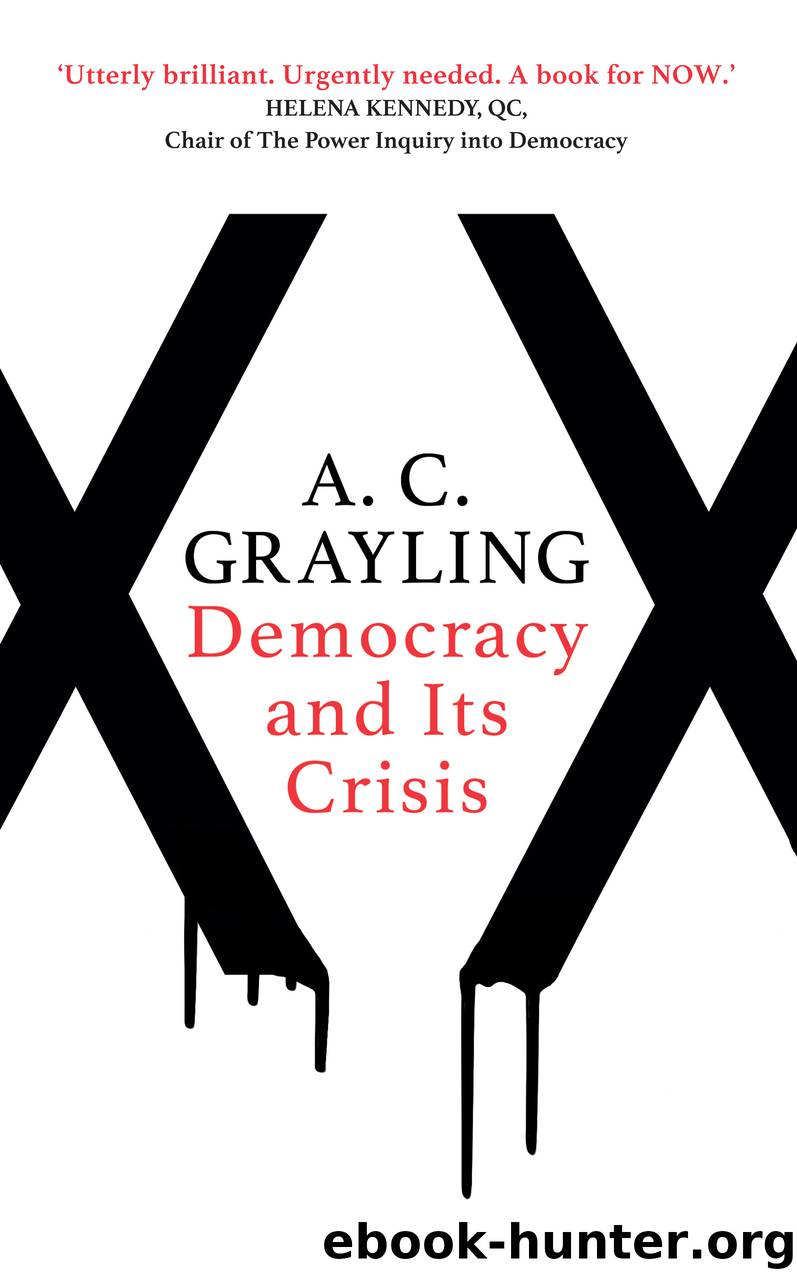
Democracy and Its Crisis by A. C. Grayling
Author:A. C. Grayling
Language: eng
Format: epub, mobi
Publisher: Oneworld Publications
Published: 2017-08-17T04:00:00+00:00
Thus, in the foregoing, the idea of representative democracy as the resolution offered by the thinkers from Putney to Mill to the dilemma of democracy.
Has it worked? The answer is far from an unqualified Yes, and arguably it is an only slightly qualified No. A Babel of criticism and suggested alternatives has grown as the decades since the mid-twentieth century have passed, from both left and right of the political spectrum, and even from its centre. Hans-Hermann Hoppe, author of Democracy – The God That Failed: The Economics and Politics of Monarchy, Democracy and Natural Order (2001), praises the libertarian criticism and proffered alternative in Beyond Democracy by Frank Karsten and Karel Beckman (2012). Christopher Achen and Larry Bartels in Democracy for Realists (2016) argue that the franchise should belong to identity groups and political parties, not individual voters, who in any case vote not as individuals but in line with their identity and party-political loyalties. Jason Brennan’s Against Democracy (2016), pessimistic about there ever being the kind of voter essentially required by democracy, prompted a debate with Philip Pettit, the latter defending a liberal view of the democratic order as conceived by the thinkers canvassed above. Their debate in effect reprises the nub of the debate from Putney to Mill.
Prompted by the same scepticisms, David Van Reybrouck’s Against Elections: The Case for Democracy (2015), Paul Cartledge’s closing remarks in Democracy: A Life (2016), theorists of ‘deliberative democracy’ inspired by Jürgen Habermas and John Rawls, proponents of anarchy, proponents of various forms of direct democracy such as the Occupy Movement’s advocacy and use of ‘participatory democracy’, government by referenda, government by sortition (lottery) – all these suggestions and alternatives reflect a dissatisfaction with the systems that call themselves democratic.
One of the phenomena singled out for special attention because it appears to capture the dissatisfaction that the peoples in democracies feel towards democracy as it has emerged in recent history, is populism. It is prompted by the feeling that government is too remote and too unresponsive to concerns at the grass-roots level, and accordingly takes the form of an upswelling of indignation and a desire to get attention and remedy. Populism leads variously to revolution at one end of the spectrum, to surprise outcomes in elections at the other. The years between 2010 and 2016, from North Africa and the Middle East to Western Europe and North America – that is, from the ‘Arab Spring’ to the Brexit and Trump phenomena in the UK and US respectively – would appear to constitute an exhibition of perfect examples of the entire spectrum of what populism is and can do. But it is arguable that in at least some of the Arab Spring movements, for example in Egypt and Syria, the first steps in revolution were not populist but led by vanguards of intellectuals seeking civil liberties and some form of democracy. Revolutions are not often inherited by those who start them, as history feelingly teaches, and Egypt, to take just one example, starkly demonstrates this.
Download
This site does not store any files on its server. We only index and link to content provided by other sites. Please contact the content providers to delete copyright contents if any and email us, we'll remove relevant links or contents immediately.
| Anthropology | Archaeology |
| Philosophy | Politics & Government |
| Social Sciences | Sociology |
| Women's Studies |
The Secret History by Donna Tartt(19083)
The Social Justice Warrior Handbook by Lisa De Pasquale(12190)
Thirteen Reasons Why by Jay Asher(8907)
This Is How You Lose Her by Junot Diaz(6885)
Weapons of Math Destruction by Cathy O'Neil(6279)
Zero to One by Peter Thiel(5799)
Beartown by Fredrik Backman(5751)
The Myth of the Strong Leader by Archie Brown(5507)
The Fire Next Time by James Baldwin(5441)
How Democracies Die by Steven Levitsky & Daniel Ziblatt(5218)
Promise Me, Dad by Joe Biden(5153)
Stone's Rules by Roger Stone(5087)
A Higher Loyalty: Truth, Lies, and Leadership by James Comey(4959)
100 Deadly Skills by Clint Emerson(4924)
Rise and Kill First by Ronen Bergman(4788)
Secrecy World by Jake Bernstein(4751)
The David Icke Guide to the Global Conspiracy (and how to end it) by David Icke(4717)
The Farm by Tom Rob Smith(4506)
The Doomsday Machine by Daniel Ellsberg(4490)
